



How Social Security Timing Can Make A $600K Difference in Taxes
Most retirees treat Social Security timing as a simple break-even calculation.
They plug their numbers into an online calculator, find the claiming age that maximizes lifetime benefits if they live to 85, and call it done.
But that single decision controls far more than monthly benefit amounts.
It determines your tax bracket positioning for 30 years, your capacity to execute Roth conversions, and whether you'll pay IRMAA surcharges that drive Medicare premiums from just over $200 to almost $690 per month.
Claiming Social Security at 62 versus 70 doesn't just change your monthly benefit. It can create or eliminate $600,000 in tax-free Roth conversion space.
This one decision controls whether 50% or 85% of your social security retirement benefits become taxable.

And it positions your retirement income for either flexibility or constraint across the three decades you'll need it to last.
What Happens When You Claim at 62 Without a Tax Coordination Plan
Consider a couple who retire at 62 with $1.5 million in traditional IRAs. Let’s call them Tom and Linda.
They decide to claim Social Security immediately to reduce the strain on their portfolio withdrawals. Tom brings in $2,400 monthly from Social Security, Linda $1,800. Combined with modest IRA withdrawals to cover living expenses, their first few years go smoothly. No dramatic tax bills. No pressure.
The plan seems to be working exactly as expected.
What they can’t see, however, is the chain reaction their claiming decision has triggered. Their combined Social Security benefits push them over the provisional income threshold where 85% of those benefits become taxable.
Every dollar they pulled from their IRAs to supplement Social Security adds to modified adjusted gross income.
This eliminates any meaningful capacity for Roth conversions without jumping into the 22% or 24% bracket.
By the time Tom turns 73 and required minimum distributions kick in, their taxable income will have climbed permanently into territory they never anticipated. At 78, Tom and Linda will be dealing with financial pressures from a decision they made 16 years earlier.
Their RMDs force them to withdraw $90,000 annually whether they need it or not. Those withdrawals trigger IRMAA surcharges that add $3,700 to their annual Medicare premiums.
The $1.5 million IRA they built has become a tax liability they can't control, and 85% of their Social Security—money they thought of as their foundation—gets taxed at their highest marginal rate.
The smooth early years masked a structural problem that compounded silently for over a decade.
What Social Security Timing Actually Controls
It doesn't have to work this way.
Social Security timing isn't a longevity bet.
It's a lever that controls taxable income during the exact years when Roth conversions and tax strategy deliver the largest lifetime retirement savings.
Break-even calculators alone aren’t enough. They compare gross benefit amounts without accounting for provisional income taxation, IRMAA surcharges, or the bracket jumps those benefits trigger when stacked on top of IRA withdrawals and required minimum distributions.
The question isn't "How long do I need to live to break even?"
The real question is: How does claiming age affect Roth conversion capacity, Medicare costs, and tax bracket positioning across the full 30 years of retirement?
When you claim Social Security determines whether you'll convert hundreds of thousands at 12% or get forced into the 22% bracket by income you can't control. It determines whether you'll pay standard Medicare premiums or watch surcharges eat 15% of your benefits annually.
This changes the entire framing. You're not just choosing when to start benefits. You're choosing your taxable income structure for three decades.
How Seaside Wealth Management Coordinates Social Security Timing with Your Lifetime Tax Strategy
This is where coordinated retirement income planning changes the equation.
It’s why Seaside Wealth Management approaches Social Security timing as part of a comprehensive system, not an isolated decision.
Year-by-Year Income Mapping
The process starts with income projections that show exactly how Social Security, required minimum distributions, Roth conversions, and portfolio withdrawals interact across every year from retirement through age 95.
This isn't generic modeling. It's built on your actual IRA balances, Social Security earnings record, and projected expenses.
MAGI Modeling Against IRMAA Thresholds
We then run modified adjusted gross income projections against IRMAA thresholds to identify the optimal Social Security claiming age based on conversion goals and Medicare cost management.
If you retire at 62 with $1.2 million in traditional IRAs, the model shows precisely how delaying Social Security to 70 opens an eight-year window to convert that balance to Roth at the 10% and 12% brackets before RMDs force you higher.
It quantifies the difference in lifetime taxes, Medicare surcharges, and flexibility under dozens of market scenarios.
Stress-Testing Against Reality
Every strategy is also tested against survivor scenarios and market volatility to ensure it holds when conditions change. If one spouse passes early, the plan accounts for the jump to single-filer brackets and the loss of one Social Security benefit.
If markets decline 30% in year three of retirement, the model shows whether delaying Social Security still makes sense or if claiming early becomes the better move.
The goal is a plan that adapts to reality, not one that requires perfect conditions to succeed.
The 8-Year Conversion Window (And How Delaying Social Security Unlocks It)
The big takeaway here is that retiring at 62 doesn't mean you have to claim Social Security at 62.
That distinction creates the foundation for tax-efficient retirement income.
When you delay claiming to age 70, you create eight years of ultra-low taxable income. This opens a window to execute massive Roth conversions before Social Security and RMDs stack on top of each other and eliminate your capacity to convert without jumping brackets.
The math is dramatic.
A couple who claims Social Security at 62 and tries to execute Roth conversions will find their provisional income threshold hit almost immediately. Converting even $50,000 pushes them into the 22% bracket once 85% of their benefits become taxable. Over eight years, they might convert $200,000 total before the tax cost becomes prohibitive.
But a couple who delays Social Security to 70 can convert $100,000 annually at the 12% bracket during those eight years—$800,000 in total tax-free conversion capacity.
That's four times the space for one-third the tax rate.
The Compounding Benefits
Delaying Social Security means more of your benefit stays tax-free when you do claim because provisional income stays lower. It keeps you below IRMAA thresholds that would otherwise add $6,000 annually to Medicare premiums for a couple.
And it positions your portfolio so that when RMDs begin at 73, a substantial portion of your retirement assets sit in Roth accounts that don't generate taxable income.
You've turned a tax liability into tax-free income that lasts the rest of your life.
What Changes When Social Security Is Coordinated with Tax Strategy
Consider what happens when Tom and Linda's advisor runs the coordinated strategy instead.
They still retire at 62, but they delay Social Security until 70.
During those eight years, they live on IRA withdrawals and execute Roth conversions up to the top of the 12% bracket annually. By age 70, they've converted $800,000 to Roth, paid $96,000 in taxes on those conversions, and positioned themselves to claim Social Security benefits that are 76% higher than what they would have received at 62.
Lower RMDs, Lower Taxes
When they reach 73 and RMDs begin, the picture looks completely different. Their required minimum distributions come from a $700,000 traditional IRA instead of $1.5 million. That generates $35,000 in taxable income instead of $90,000.
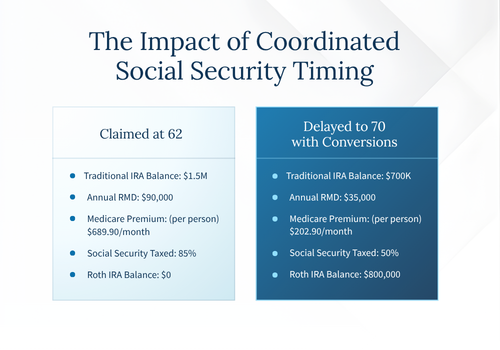
They stay well below IRMAA thresholds, so Medicare premiums remain at the standard $202.90 per month instead of jumping to $689.90.
And because their taxable income stays low, only 50% of their Social Security benefits get taxed instead of 85%.
The $800,000 they converted to Roth grows tax-free and generates income they can access without triggering additional taxes or surcharges.
Flexibility When Markets Don't Cooperate
The strategy also delivers flexibility they wouldn't have otherwise.
If markets crash early in retirement, they can turn on Social Security at 65 or 67 instead of waiting until 70. If markets perform well and their portfolio stays strong, they can delay even further and let the delayed retirement credits keep building.
The plan accounts for taxes, survivor benefits, and income coordination across scenarios, not just the one where everything goes according to plan.
That changes the internal conversation from "Will I live long enough to break even?" to "The plan holds under pressure, and we control the variables that matter."
How to Get a Coordinated Social Security and Tax Strategy for Your Retirement
The bottom line is that Social Security timing requires decade-long income modeling, not break-even calculators.
This one decision touches every aspect of retirement taxes—Roth conversions, Medicare costs, RMD management, survivor planning, and withdrawal sequencing.
Seaside Wealth Management's free "Will My Money Last?" analysis answers all the questions surrounding that decision.
Start by scheduling your free retirement analysis. We’ll walk through your IRA balances, Social Security earnings record, projected expenses, and retirement timeline.
You’ll walk away with a personalized Social Security claiming strategy and multi-decade tax projection. That means seeing exactly how delaying Social Security affects Roth conversion capacity, Medicare costs, and lifetime taxes in dollars, not just theory.
Then, all that’s left is to implement the coordinated plan that protects your income for 30 years.
You'll have a year-by-year roadmap that tells you when to claim Social Security, how much to convert to Roth, and how to position withdrawals to keep taxes and Medicare surcharges under control.
Claim your free analysis and start building a Social Security strategy that lets you keep more of your wealth where it belongs, with you.
Read More

Why Retirement Planning for Couples Isn't About Saving More

Why a SEP-IRA or Solo 401(k) Might Not Be the Best Retirement Plan for Self-Employed Business Owners

5 Things Conventional Retirement Wealth Management Gets Wrong

The Early Retirement Planning Guide To Cut $32K/Year In Avoidable Premiums

5 Retirement Investment Strategies for Modern Longevity