



Why a SEP-IRA or Solo 401(k) Might Not Be the Best Retirement Plan for Self-Employed Business Owners
A SEP-IRA or a Solo 401(k).
Pick one, open it, done.
That's the advice millions of self-employed individuals and small business owners get when they start looking into self-employed retirement options for their own business.
But which account fits you has nothing to do with the account itself, and everything to do with the business behind it.
An account is just a container, and the name on it tells you nothing about whether it's the right size for what you're pouring in. What fits depends on the size and shape of the business filling it.
That shortfall is easy to miss, because you can fund the same SEP-IRA or Solo 401(k) for a decade, watch the balance grow tax deferred, all while your income taxes climb past what that container was ever built to hold.
Meanwhile, a better-suited small business retirement plan could have sheltered far more of that income, year after year, without you saving a dollar more.
That's the difference between funding an account and building a plan.
In this article, we'll cover the benefits and drawbacks of both a SEP-IRA and a Solo 401(k), and the three factors that decide whether a different retirement plan is right for you as a self-employed person.
Why the SEP-IRA Is Simple to Open but Quick to Cap Out For Self-Employed Individuals
The SEP-IRA, short for Simplified Employee Pension, is a type of individual retirement account that appeals to self-employed people because it asks so little of them. There's no annual filing, no plan document to maintain, and no requirement to contribute in a lean year. Once it's open, the account mostly runs itself. That ease is the whole draw, and it holds up right until the business grows past it.
Seeing where it falls short means understanding how it works.
Each year, your business sets aside a percentage of what you earn, up to 25%, and that percentage becomes your contribution. It's fully tax deductible as a business expense, which lowers your taxable income for the year. Simple enough, but that 25% is also where the ceiling sits.
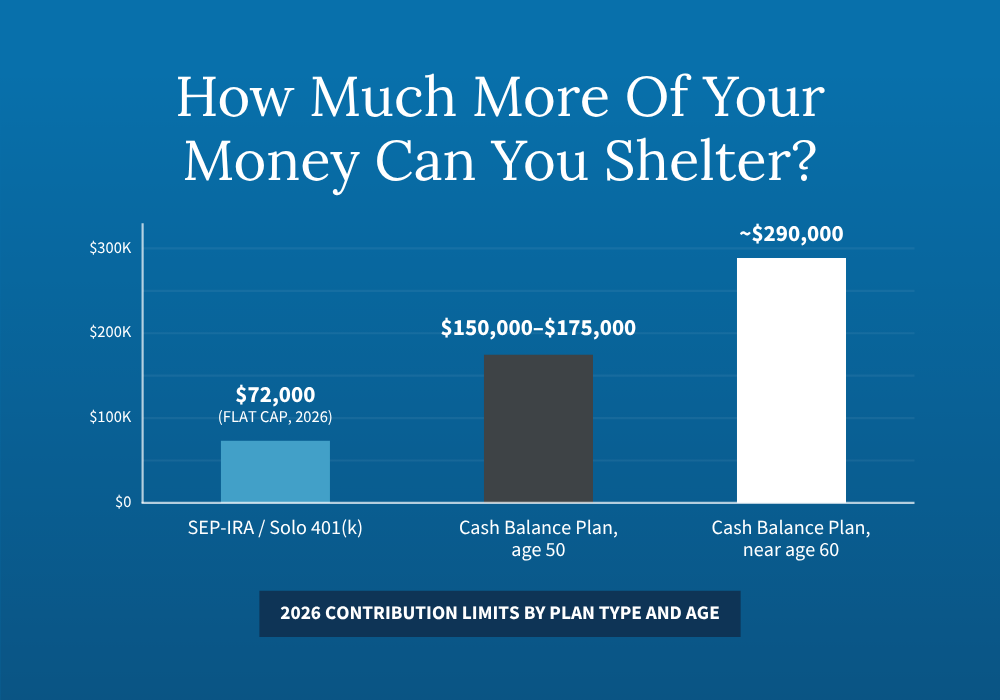
The cap is fixed, and you feel it the moment you want to save more. It can't stretch just because you had a strong year, and it gives an owner over 50 no extra room to make up for lost time. For 2026, contributions top out at $72,000, though most owners hit the percentage wall long before the dollar figure ever comes into play.
How the Solo 401(k) Offers More Room but Comes With a Catch
The Solo 401(k) is the account most solo business owners reach for once a SEP-IRA starts feeling tight.
It's the same employer sponsored plan larger companies offer, scaled down for a business with a single owner, and it was built for the earner who wants to put away more than a flat percentage of their pay.
The extra room comes from wearing two hats at once. You're both the employer and the employee. As the employee, you can defer part of your own pay, up to $24,500 in 2026, through employee contributions. As the employer, your business can add a contribution on top, up to 25% of your eligible employee's compensation, just as a SEP-IRA does. Put both pieces together and the total can reach $72,000.
That's the same overall ceiling a SEP-IRA carries, but you arrive there on far less income, because the deferral is doing part of the lifting. Owners 50 and older can add a catch-up contribution and go higher.
The added room comes with one firm condition. A Solo 401(k) only works for businesses with fewer employees. Specifically, no full-time employees beyond you and a spouse. Hire even one qualifying employee and the plan no longer fits, because it was built for an owner-only operation from the start.
For all the space it opens up, though, the Solo 401(k) still stops at $72,000. For a high earner, that ceiling can arrive with income still left over, more that a different plan could have put to work.
The Three Factors That Decide the Best Retirement Plan for Small Business Owners
The $72,000 ceiling isn't a flaw in the SEP-IRA or the Solo 401(k). It's a signal the owner has outgrown the account, and three factors about your business point in the direction of what to reach for instead, each carrying different contribution limits depending on the plan.
How Much Your Business Earns And Its Effect On Your Retirement Accounts
Matching a plan to a business starts with earned income, because income sets how much there is to shelter before any account enters the picture.
Let's examine the income of two self-employed business owners. The first nets $95,000 a year. A SEP-IRA or Solo 401(k) covers her completely, because either one offers more room than she could realistically use at that income. For an owner at this level, the search really does end at picking one of the two.
The second nets $420,000, a high income by any measure. He fills either account to the top and still has a large slice of income left over, taxed in full, with nowhere sheltered to put it.
That leftover is the whole problem.
Opening one account or the other changes nothing, because either one leaves the same gap. Both are simply too small for the income behind them.
How Your Business Is Built
As noted above, income determines how much can be sheltered, while structure determines which plans the owner is eligible to use in the first place.
Take a business earning $200,000 in profit. As a sole proprietor, the contribution is figured on net self-employment income. As an S-corp owner paying a $120,000 salary, it's figured on that salary instead. Same money, different result, because of how the business is set up.
Structure is more than which entity the business files as. It's also who's on the payroll, and payroll is the bigger lever by far.
The moment a business hires its first full-time employee, the Solo 401(k) is gone, since it only works for an owner-only operation. The SEP-IRA survives, but it turns expensive fast, because funding yourself means funding that employee's account at the same equal percentage, every year.
That's why a business with a payroll usually needs a plan that can weight the contribution toward the owner, rather than spread it flat across the staff.
How Many Years Are Left For Your Retirement Savings
Two owners can match on income and structure and still need opposite plans, and it has everything to do with time.
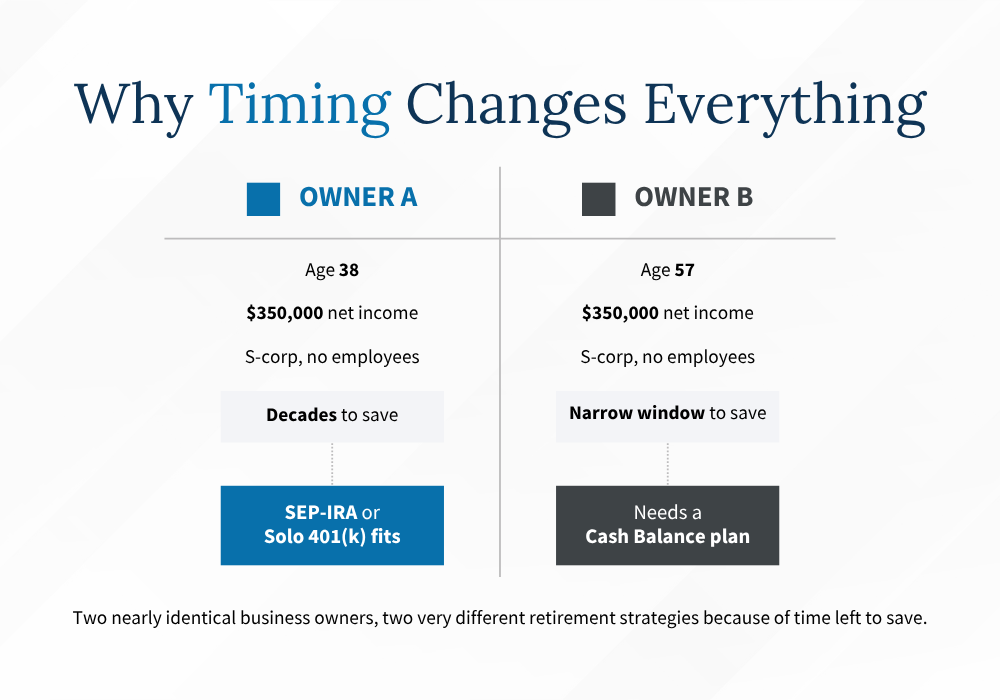
Picture a 38-year-old and a 57-year-old who both net $350,000 and both run S-corps with no employees. On paper, they look identical. What sets them apart is the number of years each has left to save.
The 38-year-old has decades of compounding ahead and room to spare inside either a SEP-IRA or a Solo 401(k). The 57-year-old is trying to move a large sum through a narrow window, and the flat $72,000 ceiling that felt generous a decade ago now stops him well short of what he could be setting aside today. Even the $8,000 over-50 catch-up on a Solo 401(k) barely dents the gap.
He needs a plan with higher contribution limits that lets an owner near retirement contribute far past what either common account allows in a single year.
Put all three factors together and the picture sharpens. A high earner with the right structure and few years left has outgrown the SEP-IRA and the Solo 401(k), and belongs in a plan most self-employed owners never hear about.
How Seaside Wealth Management Answers the Question Most Advisors Skip
Seaside Wealth Management runs the analysis your retirement plan actually requires, matching the plan to your income, your structure, and your timing instead of handing you a generic SEP-IRA or Solo 401(k) and calling it finished.
That's a departure from the norm, as most advisors name one of the two accounts and consider the job done. We don't treat the plan as a form to file once. We coordinate it with your tax strategy and your business structure as one system, so every piece is working toward the same result.
For a self-employed business owner, that's the difference between an account opened once and a plan built to keep more of what the business earns across an entire working lifetime. The account was never the goal. Keeping the money was.
That coordination is managed across our highly-experienced team of CFP® and ChFC® professionals, accounting professionals, and tax specialists who do the forward-looking planning most firms never attempt.
The Benefits of Profit Sharing and Cash Balance Plans
So if the SEP-IRA and the Solo 401(k) are too small, what does a high earner use instead?
Almost always, it’s one of two other retirement plans: a Profit Sharing plan or a Cash Balance plan. Neither turns up in a quick search for the “best retirement plan for the self-employed”, because neither is a form you open in an afternoon. Each is built around the business behind it.
The payoff for matching well is measured in real dollars. An owner who tops out at $72,000 in a Solo 401(k) can, with a Cash Balance plan, shelter well into six figures in a single year. Same income, same tax bracket, far more of it protected. It's a meaningful way to maximize retirement savings.
Which one fits, and how much room it opens, still comes back to the three factors: what the business earns, how it's built, and how many years are left.
Where Profit Sharing Adds Room to Your Contribution Limits
A Profit Sharing plan is an employer contribution layered on top of a 401(k), not a replacement for it. On paper it shares the same $72,000 ceiling a SEP-IRA carries in 2026. Its value is in its flexibility. You control how you reach that ceiling, and who the money favors when you do.
A SEP-IRA forces one flat percentage across everyone eligible. Fund yourself at 20% and every eligible employee gets 20% too, every year, good or bad. Profit Sharing is discretionary. You decide each year whether to contribute and how much, and a well-designed plan can weight the allocation toward the owner instead of spreading it evenly across the staff.
For a business with employees, that weighting is the whole point. It decides whether the contribution mostly rewards the payroll or mostly rewards the person who built the company.
Who a Cash Balance Plan Suits
While Profit Sharing still lives under that $72,000 defined contribution limit, a Cash Balance plan is where the ceiling lifts.
A Cash Balance plan is one of the defined benefit plans, closer to an old-style pension than a 401(k). Rather than a flat cap, an actuary sets the amount based on your age, income, and how close you are to retirement. Because the plan is funding a target benefit at retirement, an owner with fewer years to get there can put in far more each year to catch up.
For 2026, a 50-year-old might contribute $150,000 to $175,000, and an owner close to 60 can approach $290,000, well past anything a SEP-IRA or Solo 401(k) allows.
So the profile for this type of plan is specific. It takes high, steady income, usually above $200,000, and not many years left to shelter it. Defined benefit plans require stable, predictable income precisely because an actuary certifies the contribution each year. The 57-year-old S-corp owner from earlier, the one that flat ceiling leaves far short of what he could be saving, is close to the ideal candidate.
The tradeoff is commitment.
An actuary certifies the contribution each year, and you can't dial it up or down on a whim, so the plan needs income stable enough to stand behind it.
Choosing The Right Retirement Plan Starts With Your Numbers
The best retirement plan for a self-employed business owner starts with what the business earns, how it's built, and how many years are left to save. Once those three come into focus, the right plan tends to follow on its own.
That's why the most useful first step isn't picking an account. It's getting an honest read on your own numbers. When you understand your income, your structure, and your timeline, you can see which plan can best protect what you earn and secure your retirement income.
At Seaside Wealth Management, we help you find those answers before you commit to anything. Through our complimentary Will My Money Last? retirement analysis, one of our CFP® professionals and financial advisors will sit down with your income, your structure, and your timeline, and match the plan to the business behind it, so you can build toward your own retirement with confidence. When those numbers are clear, choosing the right plan stops feeling like a gamble and starts feeling like the obvious next step.
Read More

Why Retirement Planning for Couples Isn't About Saving More

5 Things Conventional Retirement Wealth Management Gets Wrong

The Early Retirement Planning Guide To Cut $32K/Year In Avoidable Premiums

5 Retirement Investment Strategies for Modern Longevity

How the Right Retirement Planning Services Determine Whether Your Savings Last


