



Why Retirement Planning for Couples Isn't About Saving More
Two people can spend thirty years building the same retirement savings and still end up with two different plans for it.
Nobody decides to split the plan in two. Often, it happens on its own.
One spouse retires and claims their social security benefits the same year, because that's when they stop receiving a paycheck. The other keeps working and claims later, because that's what fits their financial goals.
Before you know it, neither choice ever gets checked against the other, and both keep drawing from their own retirement accounts the way they always have.
But once you retire, you stop being two savers with two paychecks and become one household living off one pool of retirement income. And that pool has to last through both your lifetimes.
Which is why you need to consider the claiming age you each pick, the order you draw down your accounts, and how long that money needs to support whichever of you live longer, so the decisions work for both of you instead of just one.
That's the tricky part about retiring as a couple. Decisions that used to feel personal are now shared, whether you meant them to be or not.
So the question worth asking is what changes when you stop planning as two individuals and start planning as one household.
How Two Careful Savers End Up With Two Separate Plans
When married couples end up with two separate plans, it's almost never on purpose. It usually happens because each spouse made a reasonable choice, but at different times.
Let's see what that looks like by following Dave and Ellen, a hypothetical couple facing this exact scenario.
Dave and Ellen are both in their early sixties. They've maxed their 401(k)s, paid down the house, and after years of discipline, they finally feel ready to retire.
That readiness leads to three separate decisions, with each one making sense at the time they were made. Ellen decides to retire earlier, leaving the workforce earlier than Dave at 62 — years before her normal retirement age — and claiming her benefit the same year. Dave keeps working until 67, his full retirement age, since waiting grows his benefit as the higher earning spouse. And both of them continue drawing from their own IRA on their own schedule, the way they always have.
Each of those three decisions holds up fine by themself. Add them together, though, and the IRS sees something Dave and Ellen never realized.
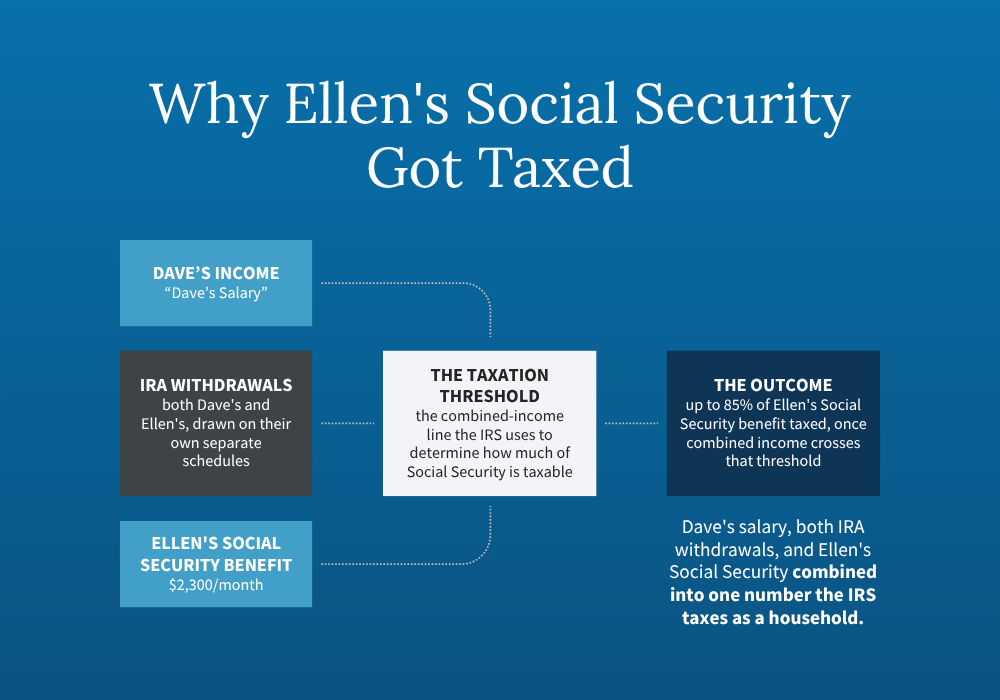
Social Security taxation is based on combined household income, not on what each spouse earns separately. For the five years Ellen collects benefits while Dave still earns a full salary, his pre-retirement income and both of their IRA withdrawals get added to her Social Security when the IRS calculates what's taxable.
That combined number pushes them past the threshold where benefits get taxed, and up to 85% of Ellen's Social Security ends up taxed at the higher rate Dave's salary already set.
Neither of them saw that increase coming, because neither of them were looking at the same plan.
Why a Couple's Decisions Only Make Sense Together
As we mentioned earlier, in retirement no financial decision belongs to one spouse anymore. You're both drawing from the same pool, so a move that's right for one retired spouse can quietly work against the other. That's why the right question isn't "is this good for me?" It's "what does this do to us?"
Claiming is the clearest example.
One spouse's choice to claim Social Security benefits doesn't only set their own benefit. It raises the couple's combined taxable income, which changes how much of the other spouse's income gets taxed.
The same is true of withdrawals.
One spouse's withdrawal order doesn't only affect their own accounts. It determines what money is left, and in which accounts, for the years the other spouse may be living on it alone.
That last point matters most, because the two of you won't need the money for the same number of years. Differences in life expectancy mean one spouse usually outlives the other by a decade or more, and the surviving spouse is left living on one Social Security check instead of two. Survivor benefits let them keep the larger of the two checks, the higher earner's benefit, but a single payment is still a steep drop from two.
So here's the hard truth. A financial plan built from smart individual decisions can still produce the wrong outcome for the household. Making those decisions fit together is the real work.
What Changes When You Plan as a Couple, Not Two Individuals
Once the household becomes the unit you plan around, the same decisions you were already making start producing better numbers.
The clearest example is one Dave and Ellen got wrong the first time through.
Last time around, Ellen claimed her benefit at 62 and Dave was still working, so their combined income was high enough that up to 85% of her benefit counted as taxable, and it stayed that way for five years.
Now let's run the scenario as a coordinated household.
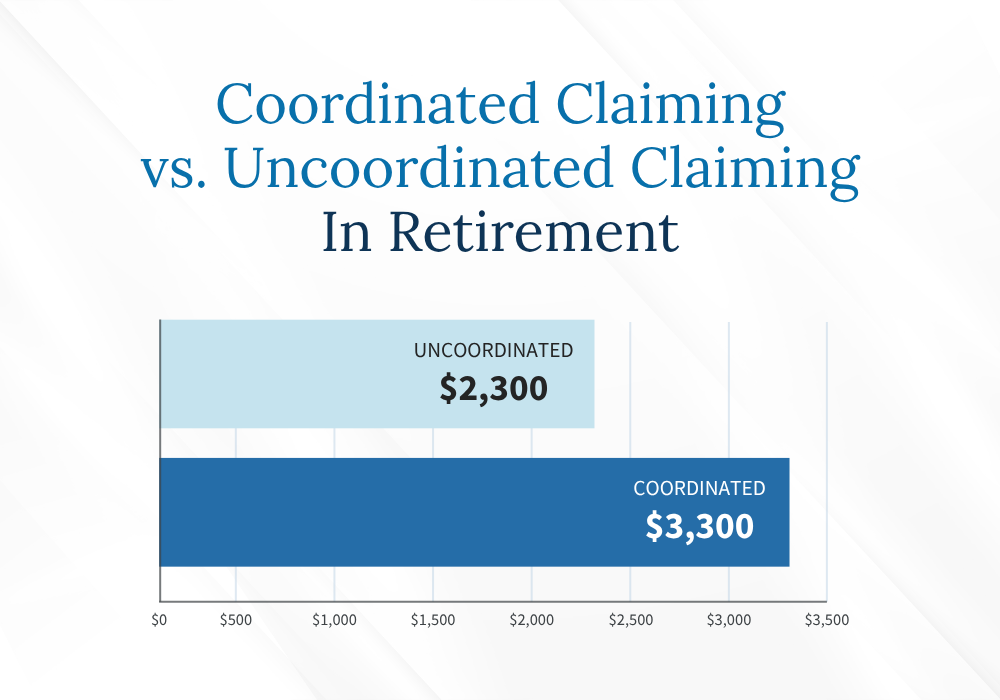
Ellen waits until Dave stops working at 67, and her benefit now arrives in lower-income years, when little of it is taxed. Waiting also raises her monthly income from about $2,300 a month to roughly $3,300, for the rest of her life.
Same couple, same savings.
The only thing that changed was the retirement timing, and it kept tens of thousands of dollars in their pockets.
That single choice is only the start.
A coordinated plan tests every major decision two ways: what it does to both of you, and what it does across thirty years or more of retirement.
Once that happens, claiming, withdrawals, and taxes stop being three separate problems and become one unified retirement strategy, solved once.
How Seaside Wealth Management Builds One Plan Around Both Spouses
At Seaside Wealth Management, our Coordinated Retirement Framework brings your income sources, taxes, and timing into a single plan built to last a thirty-year retirement. But a plan is only as good as how it's carried out, which is why we work alongside your CPA, and the tax professional who prepares your return, so what's designed on paper is what actually happens.
With that structure in place, we coordinate four decisions that shape how long your retirement money lasts as a couple, weighing each one across both of you rather than one spouse at a time.
We line up the two retirement dates you each choose, so one spouse's claim raises the income you both keep for life. Your withdrawals go on a single schedule across both accounts, which eases taxes early and protects the money one of you may rely on later. Taxes get planned around the household, so your combined income, required minimum distributions, and Roth IRA conversion windows all work to keep more in your pocket.
And your income is built to hold up for whichever spouse lives longer, so that you never have to trade comfort for financial security.
The result is a single plan built around both your lives, one you can see in full and understand.
One Financial Plan for Two Retirements
If you're a few years from retirement, there's a good chance you saved as a couple but planned as individuals.That matters more than it sounds, because in retirement, you're both drawing from one pool of money that has to last as long as either of you lives.
Working with a financial advisor who plans around the household, not one spouse at a time, is what makes your two plans work as one. Seaside Wealth Management sets your claiming ages, withdrawals, RMD timing, and Roth conversion windows against each other instead of one at a time. And our team keeps that plan in step with your CPA so it holds up on the actual return, not just the projection.
If you're interested in seeing where your two plans quietly work against each other, start with our complimentary Will My Money Last? Retirement Analysis. We'll run both incomes and both retirement timelines against a thirty-year retirement and show you, in dollars, where coordinating one decision leaves more for both of you.
Read More

Why a SEP-IRA or Solo 401(k) Might Not Be the Best Retirement Plan for Self-Employed Business Owners

5 Things Conventional Retirement Wealth Management Gets Wrong

The Early Retirement Planning Guide To Cut $32K/Year In Avoidable Premiums

5 Retirement Investment Strategies for Modern Longevity

How the Right Retirement Planning Services Determine Whether Your Savings Last


